Kam Wah Chung and the History of Chinese Herbal Medicine in the American West

Updated: Aug 16
Americans may not want Chinese herbal medicine, but we need it.
You might not ever find yourself in John Day, Oregon. It is a dusty, middle-of-nowhere town located north of the Blue Mountains and several hours drive from any urban hub. As you whiz though on Hwy 26 it’s all too easy to miss the small Historical Landmark sign by the side of the road, marking one of Eastern Oregon’s hidden gems: the Kam Wah Chung State Heritage Site.
Described in the site literature as a “time capsule”, Kam Wah Chung is a small building of stone and pine, painted bright turquoise and red. From the late 1880s to 1940s, it served as a Chinese herbal medicine clinic, general store, community center, and refuge to the Chinese immigrants who lived in John Day. It was also home to Doctor Ing Hay, known locally as “Doc Hay”, and his business partner and friend, Lung On.
My wife and I first visited Kam Wah Chung in 2021. We were driving out to spend a week rafting the John Day river, and it was the third time we’d driven past the sign saying, “We’ll check it out on our way back.” We were never going to stop on the way back. The way back was always hot, hungry, and at least a little agitated from the abrupt shock of leaving the peace of river life. We stopped for gas and I said, “Let’s just see if we can pop in there for thirty minutes and then get back on the road.” Sure enough, we were able to jump on a tour that left a few minutes after we arrived.

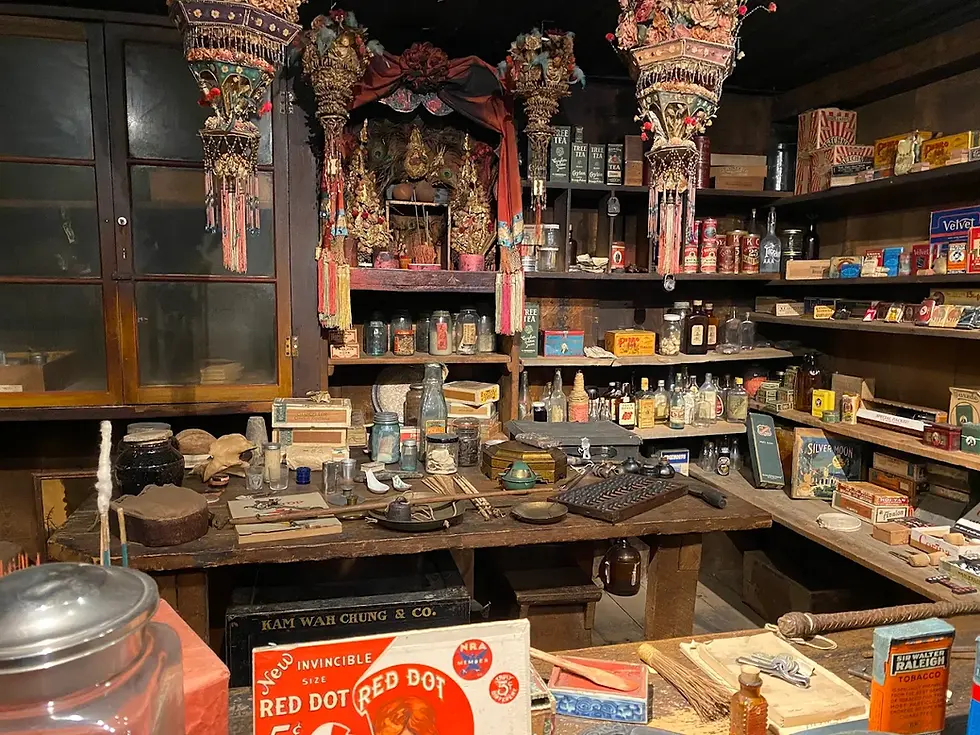
The description of “time capsule” turned out to be accurate. When we entered the small building, it was like stepping back in time; products and tools from a different era lined the shelves, and in the pharmacy, a vast collection of vintage Chinese herbs. As I peered at the familiar names of plants and minerals I use daily in my Chinese herbal medicine practice, I was struck by the persistence and power of this medicine. If we were to visit the clinical space of a western medical doctor from this same time period, we would find almost nothing still in use - or even deemed safe - by today’s standards. Chinese herbal medicine has been using the same reliable means to help people not just since the 1880s, but since 200 BC! And yet, the vast majority of Americans do not utilize it, and many actively revile it.
The history on display revealed a lot about the relationship between Americans and immigrants, about our attitudes towards new ideas and new medicines, and how we treat things that are ‘different’. Though we would like to believe that bigotry and closed-mindedness are attitudes of the past, unfortunately they are alive and well in the 21st Century.
And yet still Chinese Medicine in the United States persists, against all odds, just as Doc Hay persisted in helping thousands of people across the American West despite threats to his life and property from his own neighbors.
Doc Hay the Chinese Herbalist
The first thing to know about “Doc” Ing Hay is that he was a TCM herbalist. When Americans think of Traditional Chinese Medicine they think of acupuncture. As a culture we are obsessed with procedures, medical interventions where we show up and passively get poked, prodded, or cut open. Don’t get me wrong, acupuncture is wonderful. But acupuncture is just one branch of TCM. Chinese herbal medicine is the root, the trunk, the powerhouse that puts the medicine in Traditional Chinese Medicine. Not only is it far older than acupuncture, it is chemical medicine, the ancestor of every modern medication we’ve ever made.
In order to truly understand what Doc Hay was doing in John Day, OR, we need some historical context. Doc Hay was successfully treating patients for serious, life-threatening maladies. We’re talking about typhoid fever, influenza (including the Spanish flu of 1918!), rattlesnake bites, polio, gangrene, frostbite, and sepsis, in addition to more day to day maladies such as insomnia, back pain, headaches, constipation, infertility, etc. We know this because he treated many people via correspondence, and some of those letters, as well as his formula prescriptions, have been preserved.
The practice of TCM wasn’t licensed and regulated in the U.S. until the 1970s. Doc Hay was brought to court three separate times for “practicing medicine without a license”. Every time, the courtroom was flooded with his patients, demanding the charges be dropped. Despite the pervasive anti-Chinese sentiments of the time, when push came to shove, they needed him. He was a really good doctor.
Western medicine during the late 1800s would be unrecognizable to us today, and, frankly, it was pretty scary. There were no antibiotics. The only vaccine available was for smallpox. The “medicines” western doctors used on a regular basis included lead, mercury, arsenic, and prescriptions for opium, whiskey and cocaine.
Chinese herbal medicine on the other hand was a fully developed system, thanks to the early development of writing in China, a culture that didn’t repeatedly destroy their own medical and scientific advancements, and generations of brilliant and hardworking herbalists. TCM had already spent centuries developing complex strategies for treating all kinds of diseases. Even today TCM herbal treatments can still outperform modern drugs in many cases, ranging from infections to pain to digestive conditions.
Doctor Ing Hay was an exceptional individual, for reasons we’ll cover next, but any halfway decent TCM herbalist in the 1880s would have run circles around western doctors.
When does a doctor need an armored front door? When he’s a Chinese immigrant in the American West.
One of the first things you’ll notice if you visit Kam Wah Chung is the front door. It’s covered with a mosaic of metal plates. You won’t have to wonder why for long, because soon your eye will catch on the dozens of bullet holes in the metal.
Chinese immigrants came to John Day to work mining gold. During the mid to late 1880s there was growing anti-Chinese sentiment in the US, culminating in the Chinese Exclusion Act of 1882, the first major piece of American legislation to ban immigration based on race and nationality. The entire country was an unfriendly place for Chinese immigrant workers, and Eastern Oregon, aka the wild west, was outright dangerous. It was a common occurrence for local cowboys to ride through Chinatown, shooting anything that moved and looking for trouble.
When you go inside Kam Wah Chung, you’ll see a well and water pump right in the middle of the kitchen. This was so they could avoid going outside after dark. To leave the building at night was to risk harassment, injury, or worse.
The dissonance between the two parallel stories of Kam Wah Chung is striking. On one hand, its chief resident, Doc Hay, was the best doctor for hundreds of miles and many people owed him their lives and health. On the other, those same people, or at least their family and friends, harassed and attacked Kam Wah Chung at every opportunity.
Talk about biting the hand that feeds you!
The mid to late 1800s were a time of relative lawlessness in the American west, communities were insular, and racial violence was commonplace. Though we have moved forward from this state of affairs in many ways, attitudes towards ‘Chinese things’ have remained generally poor, with a strong and typically unacknowledged underpinning of scorn.
As far as people's relationship with Chinese medicine goes, not much has changed since Doc Hay’s time.
Only about 2% of Americans get acupuncture. Far less than that get Chinese herbal medicine treatment. Nearly all states license TCM practice under an acupuncture license, so all licensed TCM herbalists in America study acupuncture. However, most acupuncturists do not practice Chinese herbal medicine. I would venture that less than 10% of US acupuncturists are capable of writing a halfway decent herbal formula. So the amount of Americans getting TCM herbal medicine treatment is well under 1%.
Virtually no one comes to Chinese herbal medicine as their first, or even third, stop on a healing journey. I see people for complex chronic illnesses, and most of them have slipped through the cracks of Western medicine. They’ve gone to their doctor, and even though that doctor has failed them for years or decades, they kept going back. You often hear people talking about the ‘placebo effect’ and the need to ‘believe in’ Chinese medicine. But the fact is no one in America believes in Chinese medicine. Belief is when you go back to the doctor that failed to treat your problem. Belief is when you’re at the ER again even though it didn’t help before.
People come to Chinese herbal medicine when they have “tried everything”. But they hadn't tried everything. They had skipped the oldest and most sophisticated system of natural medicine in the world! Why don't we think to try that first? Why do we spend tens of thousands of dollars on supplements, international health tourism, blood transfusions, horse de-wormers, coffee enemas and liquid diets before we will try Chinese herbal medicine?
I think about this a lot, and I can find no rational explanation other than a deep cultural bias against foreign ideas and culture.
It’s not that, one might argue. People just don’t know about Chinese medicine. Or: it's not covered by insurance. It’s too expensive.
It’s actually not.
TCM is incredibly inexpensive relative to other options. In my first year of practice I treated a patient who had spent $10,000 after insurance coverage for being hospitalized for antibiotic resistant pneumonia. She was discharged but her symptoms hadn’t improved at all. I treated her successfully with 2 weeks of herbs, for a grand total of $220.
As for a plea of ignorance... well, perhaps. But this is where Kam Wah Chung comes in. Chinese medicine has not only been around for thousands of years, it’s been right here in America since the 1880s, probably earlier. It isn’t that it’s not here, it’s that we as Americans don’t seem to want it. But, just like the residents of the 19th century American West, we do need it.
$356,000 in uncashed checks
Kam Wah Chung is a small building. As you enter, Doc Hay’s room is immediately to your left. When the building was first reopened around 1980, they found a few things in the room. A small bed, a chair, a meat cleaver, and a drawer full of uncashed checks.
This is another extraordinary thing about Doc Hay: he didn’t just treat people in John Day while the Chinese settlement got shot up, or while he was taken to court for practicing without a license. He treated many of them for free. Adjusted for inflation, the amount in his dresser drawer was estimated at $356,000 in today’s dollars!
Without a doubt Doc Hay faced more hardships in life than I have or ever will. But one area where he did have a leg up was - oddly enough - financially. Doctor Ing Hay’s medical practice was bankrolled by his friend and associate Lung On. So while he certainly deserved to be paid, Doc Hay didn’t need to cash the checks to get by.
Lung On was the businessman who ran the general store and a variety of other business ventures like selling cars, managing mining claims, and renting properties. Amazingly, he was one of the richest men in John Day at the time of his death. This pairing of wealth and medical practice is actually a very old tradition in Chinese culture, though it historically ran in families rather than friendships. Many of the famous scholars and doctors in Chinese medicine came from wealthy families. If you were born in a wealthy family, there was still an obligation to do something of value with your time, with medicine and philosophy being prime examples. If you had to toil in the fields all day it was hard to learn medicine. Conversely, if you didn’t have to work, but you’d better do something - you have the time and energy to learn medicine. So many doctors throughout Chinese history helped patients for very little to no money, because they didn’t need it.
This phenomenon is not exclusive to China. Historically doctors in the West also came from privilege, and did not need to earn a living at their practice, thereby being able to provide affordable treatments to those in need.
If only that was how things worked today!
(As an aside, if you are a wealthy business mogul and want to team up Lung On and Ing Hay style...feel free to hit me up anytime.)
During Lung On and Doc Hay’s lifetimes they did okay financially. But after their death, it was a different story.

I mentioned that at the time of his death, Lung On was one of the wealthiest men in John Day, worth the modern equivalent of 1.6 million dollars. He left the Kam Wah Chung property to Doc Hay, and intended the money to go to his family in China. His wife and daughter could not travel to the United States due to the Chinese Exclusion Act of 1882, and the US government blocked any transfer of the money to China when the country entered WWII. In the end, Lung On’s money never made its way from the local government of John Day back to his family.
When Doc Hay eventually died in 1952, his money also couldn’t be sent overseas to his family. The Kam Wah Chung property was deeded to his nephew Bob Wah, and ultimately it was gifted to the city of John Day under the express condition that it would be turned into a museum.
Unfortunately, this did not happen. Kam Wah Chung was shuttered and essentially forgotten. The other buildings in the complex were knocked down to make way for a municipal pool. According to our tour guide, Kam Wah Chung only escaped a similar fate by chance - a couple of teenagers broke in one night in the late 1960s and discovered a perfectly preserved Chinese general store and pharmacy - the time capsule we find today. The Oregon Historical Society got involved, and eventually Kam Wah Chung achieved status as a State Heritage Site.
I, for one, am very glad Kam Wah Chung narrowly escaped destruction, and is available to the public. It is a rare peek into the reality of Chinese immigrant life in the American West, and an even rarer insight into the history of American Chinese herbal medicine.
When we arrived home after that first visit, I was eager to learn more, and logged onto the Friends of Kam Wah Chung website. I was confronted by a banner which read: “The largest intact collection of Chinese medicine and formulas in the world.”
The world?
Oh, Friends of Kam Wah Chung.
I imagine that the author of that statement didn’t put much thought into it. An honest mistake. Ignorance perhaps, to fail to consider that the country of Chinese medicine’s birth, a country with one of the earliest writing systems in human history, with meticulously kept written records pre-dating the birth of Christ, with a history famous for preserving this medicine in an unbroken lineage for thousands of years where other cultures burned their scientists and doctors to the ground ten times over. Yes, I think that country - China - just might have better historical collections on Chinese medicine than this very cool, but very small, dusty building in the American West. But I don’t think ignorance accurately describes this oversight. It is more along the lines of willful blindness, or a subconscious attempt at erasure of the very culture the museum is promoting.
I appreciate Kam Wah Chung, but I hope they rethink that banner.
Duck fat soap
One of the most striking things about Kam Wah Chung is looking around at the shelves stocked with goods and realizing that there is no plastic. Anywhere. Every item is packaged in metal cans, tins, paper wrapping, or wooden boxes. Like everyone else alive today, I’ve never known a world without plastic. Yet this old shop shows us that it is absolutely possible.
I scanned the shelves with interest, my eye landing on a stack of little bars wrapped neatly in brown paper - duck fat soap. I would never desecrate a historical site, but damn, I’d love to try some duck fat soap. Of course my guess is that it’s terribly rancid by now, but who knows - I don’t know much about making soap.
As we walked slowly through the dim interior of Kam Wah Chung with our tour group, I listened as people exclaimed over the herbal products, oohing and ahhing over the archaic-seeming practice of tongue and pulse diagnosis, the formula combinations of magical-sounding herbs, and the array of serious illnesses Doc Hay used these tools to treat.
I smiled to myself; these things are part of my workday - not museum artifacts.
As we headed out I overhead someone say, “I wish this still existed.”
It does! I wanted to shout. Why wouldn’t it?
The irony is that some of the best American Chinese herbalists in the US practice only hours away from John Day in Portland, Seattle, and San Francisco.
The tour finished at a large display of letters written to Doc Hay by patients too far away to come see him in person. People described their symptoms, then he packaged up a formula of herbs and mailed it to them.

As I leafed through the letters, I felt a strong sense of kinship with this man I had never met, living in a time and place fraught with hardship it's difficult for me to imagine. Despite our many differences, I am essentially carrying on the same work he was doing, in close to the same place. Doc Hay communicated with his patients via post - a slow and arduous process in the 1880s American West - whereas I am lucky enough to have instant communication via email and text, as well as high resolution tongue photos to study. Nevertheless, I imagine he, like me, poured over his patients' descriptions of their ailments, trying to make sense of a constellation of symptoms, fill in the gaps, and craft an herbal formula to bring them back toward health.
There is a lot about Kam Wah Chung that troubles me - the history of xenophobia, racism, violence, and closed-mindedness - but there is also a lot that energizes me. Chinese herbal medicine persists, not because people seek it, beg for it, or often even want to pay for it. It persists because of the people who are passionate about it, like Doc Hay, like all my teachers, and like me, and because there are always going to be people who need it.
Sincerely,
Sean Dugan L.Ac.
Sean Dugan L.Ac. is a licensed and board-certified herbalist and acupuncturist. He holds a Master’s degree in Chinese Medicine from the Oregon College of Oriental Medicine as well as a Diplomate in Chinese Medicine from the NCCAOM. He has studied under many Master Herbalists including Dr. Guohui Liu, Dr. Jimmy Wei-Yin Chang, Dr. Fang Zhang, Dr. Greg Livingston, and Dr. Darren Huckle. Sean’s herbal medicine practice draws from both Traditional Chinese Medicine and Classical Chinese Medicine treatment methods, with a focus on clinical efficacy above all. He has been treating patients with Chinese Herbal Medicine since 2013.
Where can you find a Chinese herbal medicine practitioner?
This list is not exhaustive by any means, this is a list of practicing TCM herbalists who are the first that come to my mind and that I consider excellent practitioners.
Sean Dugan - I help clients locally in Boise, Idaho and all over the US through online consultations and herbs by mail. You are already on my website, nice! Just navigate to my clinic using the menu bar at the top of the page.
Guohui Liu - Bellevue, WA. https://acupuncturema.com/guohui-liu-l-ac-licensed-acupuncturist/
Fang Zhang - Portland, OR. https://portlandacupunctureherb.com/practitioners
Greg Livingston - Seattle, WA and online / telehealth. https://www.drgreglivingston.com/
Darren Huckle - Santa Cruz, CA. https://rootsofwellness.net/
Travis Kern - Portland, OR. https://www.rootandbranchpdx.com/
Travis Cunningham - Portland, OR. https://www.rootandbranchpdx.com/
Jimmy Chang - Hacienda Heights, CA. https://www.jimmyclinic.com/
Tina Chen - La Puente, CA. https://tinachenherbs.com/